
How to Protect Elderly Parents from Online and Phone Scams: The 2026 Family Guide
Adult children lose sleep over this. A step-by-step playbook to shield your mom or dad from phone, text, email, and online scams in 2026 — including the exact scripts to say, free tools to install today, financial safeguards, and what to do the moment you suspect they've been scammed.
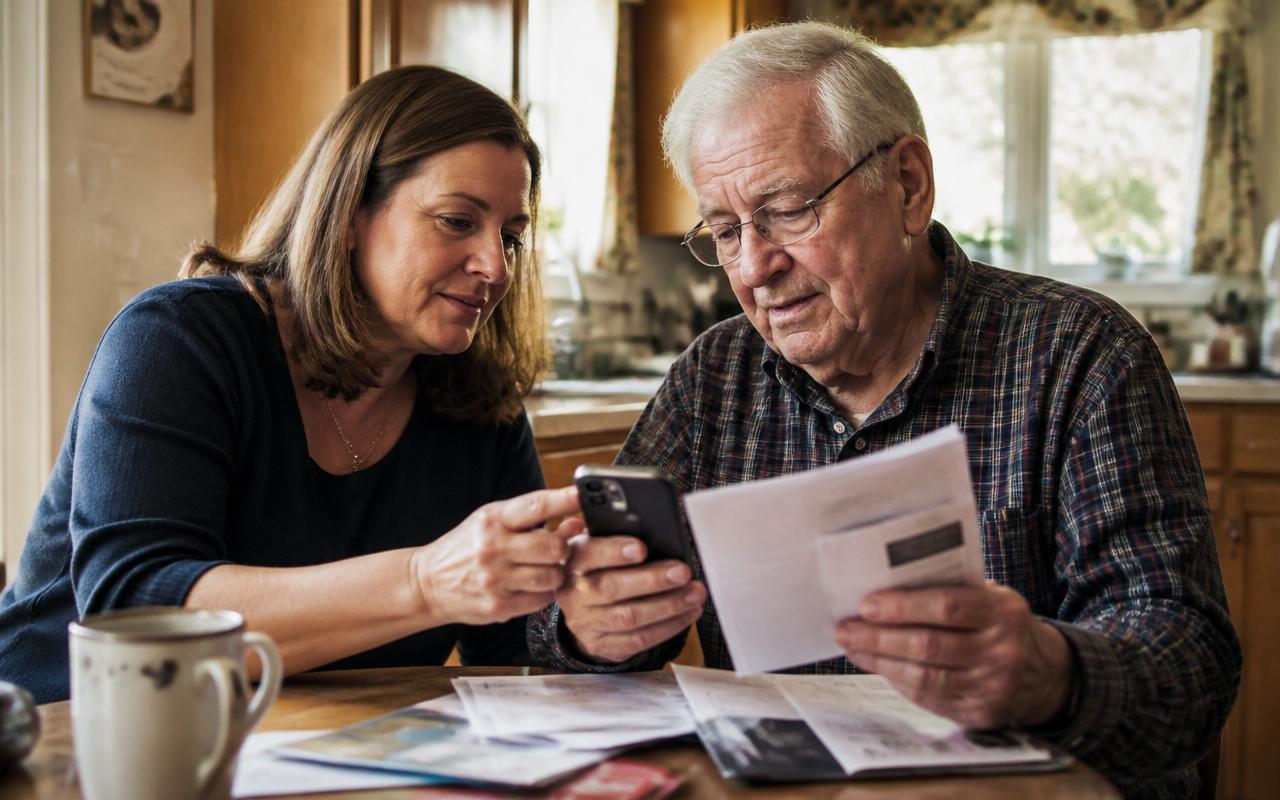
If you're reading this, you already know the feeling. Your phone lights up with a call from Mom or Dad — and for a split second, your stomach drops. Did they answer that number? Did they click that link? Did they wire money to the 'grandson' who said he was in jail? In 2026, adult children are the last line of defense between aging parents and a global fraud industry that pulled $3.4 billion from Americans over 60 last year alone, according to the FBI's most recent Elder Fraud Report — and that's only the fraction that gets reported.
The good news: you don't need to become their full-time bodyguard. A handful of conversations, four free technical safeguards, and two financial safety nets stop the overwhelming majority of scams before a single dollar moves. This guide is the exact playbook we walk Safe Retire Watch families through — plain-English, no jargon, and doable in one weekend.
Why scammers specifically target elderly parents
Understanding the 'why' makes every safeguard below click into place. Retirees are not targeted because they're careless — they're targeted because criminals have profiled them. According to the FTC, FBI, and AARP Fraud Watch Network, three factors combine to make Americans over 65 the single most profitable demographic for phone and online fraud.
- Accessible savings. A lifetime of retirement accounts, home equity, and pensions means a single successful scam can net six figures. The FBI reports the average loss per victim over 60 is now $34,000 — more than seven times the average for victims under 40.
- Landline answer rates. Adults over 65 still answer roughly 80% of incoming calls, versus under 20% for adults under 40. Scammers auto-dial millions of numbers a day; every answered call is a lead.
- Politeness and authority reflex. A generation raised to respect officers, doctors, and 'the government on the phone' is exactly the audience an impersonation script is engineered for. It's not naivety — it's cultural conditioning being weaponized.
None of this is your parent's fault, and framing it that way matters — because shame is what keeps most seniors from telling their family they were scammed until it's too late to recover the money.
The 8 scams hitting elderly parents hardest in 2026
You can't defend against what you can't name. Show this list to your parent — printing it out and taping it near the phone works surprisingly well.
- Government impersonation — Social Security, Medicare, IRS, or jury duty calls threatening arrest, benefits cancellation, or fines. Real agencies do not call demanding payment.
- Grandparent / AI voice-cloning — a 'grandchild' calls in distress from jail, a hospital, or a foreign country and begs you not to tell their parents. In 2026, scammers clone the grandchild's voice from three seconds of social-media audio.
- Tech support pop-ups — a full-screen browser alert claiming the computer is infected, with a phone number to call 'Microsoft' or 'Apple.' Neither company ever puts a phone number in a virus warning.
- Romance scams — a widowed parent meets someone on Facebook, a dating site, or 'Words With Friends' who is warm, attentive, and always one emergency away from needing a wire transfer. Losses average $18,000.
- Medicare fraud — callers offering 'free' back braces, DNA tests, or new plan cards in exchange for a Medicare number, which is then used to bill fraudulent claims.
- Sweepstakes / Publishers Clearing House — 'You won! Just pay the taxes/fees up front with gift cards to release the prize.' Real sweepstakes never require payment.
- Utility shutoff — 'Your power will be cut off in 30 minutes unless you pay now.' Real utilities send written notices weeks in advance.
- Pig butchering / crypto investment — a friendly new contact on WhatsApp or text who teaches your parent to invest through a fake trading app that shows fake profits until they try to withdraw.
The conversation: how to talk to your parent without offending them
This is the step most families skip, and it's the one that determines whether every other safeguard actually gets used. Approach it like a home safety upgrade, not an intervention. Sit at the kitchen table, not across a desk. Do it once, calmly, and never in front of grandchildren.
The script that works
"Mom, I read something scary this week — these scam call centers now clone voices from three seconds of a Facebook video. They're fooling FBI agents and bank presidents. This has nothing to do with being sharp — it's a whole industry. Can we set up a couple of things together, the same way we have a smoke alarm?" Notice what that opener does: it names the threat, removes shame, uses the word "we," and asks permission. Nine out of ten parents say yes.
The four agreements to reach in that first conversation
- The 'call me first' rule: any request for money, gift cards, wires, or account info pauses until we talk — no matter how urgent it sounds.
- A family safe word: a random word (favorite pet's name, childhood street) that any real family member in real trouble will say when asked. AI voice clones don't know it.
- Permission to add view-only access to bank accounts so you can spot fraud early — you are not taking over their money.
- Permission to enable call-screening on their phone and to install a link-checker they can text suspicious messages to.
4 free technical safeguards you can set up in one weekend
You do not need to buy expensive senior-specific hardware. The best defenses are already on their phone and computer — they just need turning on. Plan to spend an unhurried Saturday morning together with a fresh cup of coffee.
1. Turn on carrier-level call blocking (free)
Verizon Call Filter, AT&T ActiveArmor, and T-Mobile Scam Shield are all free and block a large share of known scam calls before the phone even rings. On iPhone, also enable Settings → Phone → Silence Unknown Callers. On Android, enable the Google Phone app's spam and caller-ID protection. Combined, these cut incoming spam by roughly 80% with zero ongoing effort.
2. Install a link checker they can text suspicious messages to
The single most common 2026 scam vector isn't a call — it's a text with a link (fake USPS delivery, fake toll bill, fake bank alert). Bookmark a free link-safety checker like Safe Retire Watch's free link check tool on their home screen. When any suspicious text arrives, they paste the link before tapping it. Practice it with them twice while you're sitting there.
3. Freeze their credit at all three bureaus (free, takes 15 minutes)
A credit freeze prevents anyone — including scammers with a stolen Social Security number — from opening new accounts in their name. It's free, does not affect their credit score, and can be unfrozen anytime online. Do all three: Equifax (equifax.com/personal/credit-report-services), Experian (experian.com/freeze), TransUnion (transunion.com/credit-freeze). Save the PIN each bureau gives you in a password manager.
4. Enable transaction alerts on every account
In each bank and credit card app, turn on push or text alerts for every transaction over $1 (yes, $1 — not $500). Fraudsters test with a tiny charge before draining the account. Real-time alerts, sent to both you and your parent, mean a fraudulent charge is disputed within minutes instead of after the monthly statement.
The 3 financial safeguards that stop the biggest losses
The technical steps above stop most scams from starting. These three safeguards stop losses when a scam does get through — and they're what elder-law attorneys and CFP fiduciaries put in place for their own parents.
1. Designate yourself as a 'trusted contact' at their bank and brokerage
Under FINRA and federal banking rules, a trusted contact is someone the bank can call — without violating privacy — when they see signs of elder financial exploitation. You are not a joint owner and cannot move money. You are simply the person who gets a phone call before your parent wires $30,000 to "the IRS." Every major U.S. bank, Fidelity, Schwab, and Vanguard support this in 10 minutes online.
2. Set daily transfer and wire limits
Ask the bank to lower daily Zelle, wire, and ATM limits to something realistic for your parent's normal life — often $500–$2,500. Most seniors never wire anything, ever; a $500 daily cap makes a catastrophic six-figure loss mechanically impossible in a single scam call.
3. Get a durable power of attorney in place — before you need it
A durable financial POA, drafted by an elder-law attorney (~$300–$600 in most states), lets you step in immediately if there's cognitive decline or active exploitation, without going to court. Do this while your parent is healthy and consenting. Waiting until a crisis often means an expensive, adversarial conservatorship — exactly the situation the POA is designed to avoid.
What to do the moment you suspect your parent has been scammed
Time is money — literally. Wire transfers can sometimes be recalled within 24 hours and almost never after 72. Gift cards can be frozen by the issuer if reported the same day. Zelle and debit-card disputes have a much higher success rate when filed within 48 hours. Move fast, in this order.
- Call their bank and every card issuer. Ask for a fraud freeze on the accounts and dispute pending transactions under Regulation E (electronic) or Regulation Z (credit cards). Cite "authorized push payment fraud" or "senior impersonation scam" — 2024–2025 CFPB guidance significantly expanded reimbursement in these categories.
- Place a free fraud alert and credit freeze at all three bureaus if any personal info was shared (SSN, DOB, address).
- Change passwords on email, bank, Apple/Google, and Amazon accounts — from a device the scammer never touched. Enable two-factor authentication on all of them.
- If gift cards were sent, call the issuer's fraud line immediately: Apple 1-800-275-2273, Google Play 1-855-466-4438, Target 1-800-544-2943, Best Buy 1-888-237-8289. Some cards can still be frozen within hours.
- File official reports: FBI IC3 (ic3.gov), FTC (reportfraud.ftc.gov), your state Attorney General, and, for grandparent or wire scams, the U.S. Postal Inspection Service (uspis.gov).
- Call the National Elder Fraud Hotline at 1-833-372-8311. A DOJ case manager is assigned to you, for free, and stays with the family through recovery and prosecution.
Free tools we recommend to every family
- Safe Retire Watch's free scam checker — paste any suspicious text or email for an instant AI-powered verdict written for retirees.
- Safe Retire Watch's free link check — check any URL before your parent clicks it.
- AARP Fraud Watch Helpline — 1-877-908-3360, free, staffed by trained volunteers.
- National Elder Fraud Hotline — 1-833-372-8311, run by the DOJ Office for Victims of Crime.
- Eldercare Locator — 1-800-677-1116, connects families to local Adult Protective Services.
The bottom line for adult children
Protecting an elderly parent from scams in 2026 is not about watching them 24/7. It's about setting up a handful of layered defenses — one honest conversation, four free technical safeguards, three financial safety nets — and then trusting the system to catch what slips through. Families who put this playbook in place before a crisis almost never become one of the FBI's $34,000-average loss statistics. Families who wait until after the first scam almost always do.
Start with the conversation this weekend. Set the family safe word tonight. Everything else on this page can be checked off in a single Saturday. Your future self — and your parent — will be grateful you didn't wait.
Paste a suspicious text or email — instant AI verdict.
Paste any URL before you click — free phishing check.
Get scam alerts before they reach you
Safe Retire Watch sends real-time alerts when new scams target retirees in your state. From $12/month. 30-day money-back guarantee.
Get Protected