
Jury Duty Scam 2026: The Fake Court Summons Call That's Draining Seniors' Bank Accounts
A caller claims you missed jury duty and a federal warrant is out for your arrest — unless you pay a fine right now. It's the #1 scam hitting retirees in 2026. Here's exactly how the jury duty scam call works, the 7 warning signs, what real courts actually do, and how to get your money back if you already paid.
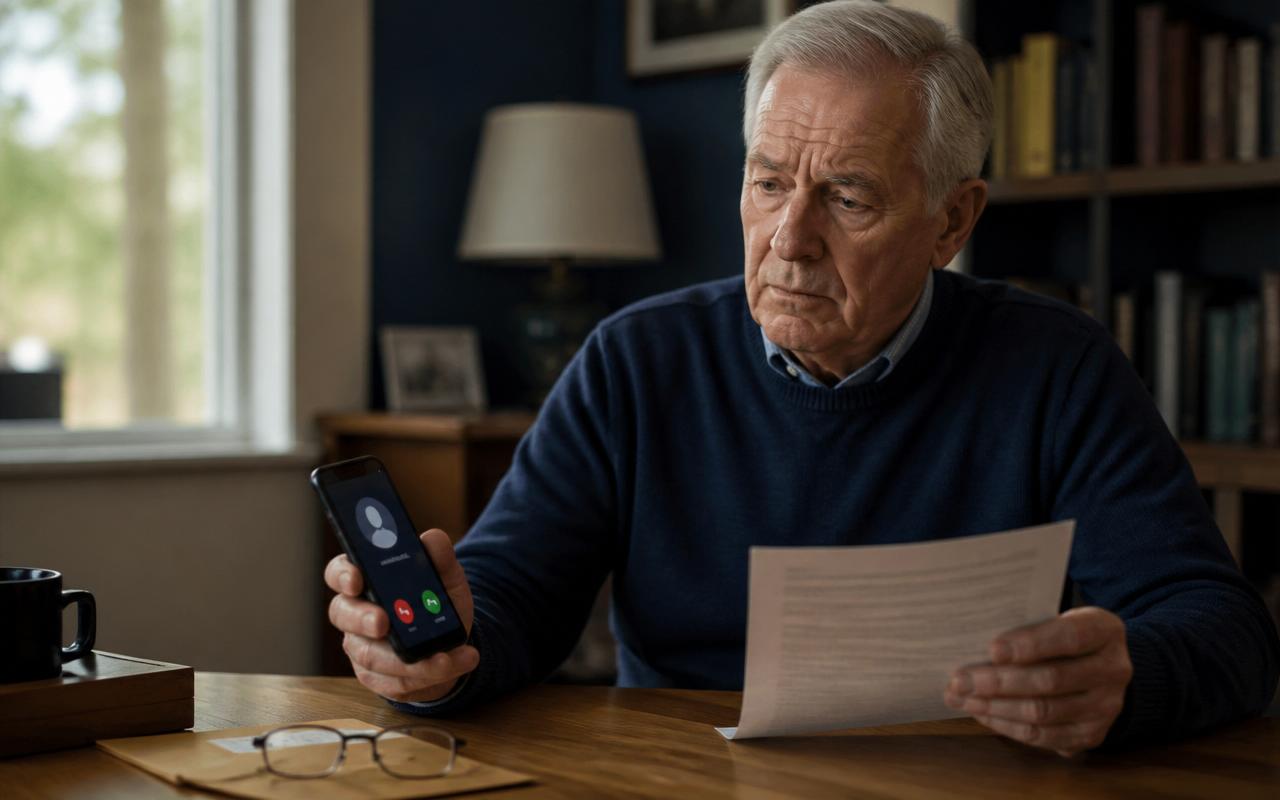
Your phone rings. The caller ID says "U.S. District Court" or your county sheriff's office. A serious-sounding voice tells you that you failed to appear for jury duty, that a federal warrant has been issued for your arrest, and that officers are being dispatched to your home right now — unless you pay a $1,500 fine in the next 30 minutes. He knows your name. He may even know your birthday, your street, the last four of your Social Security number. He tells you to stay on the line, drive to CVS, and pay in Apple gift cards or by Zelle.
This is the jury duty scam, and in 2026 it is the fastest-growing phone scam targeting Americans over 60. The FBI, the U.S. Marshals Service, and federal courts in more than 40 states have issued warnings. AARP's Fraud Watch Network estimates victims lose an average of $2,800 per call, and many lose $10,000 or more. If you or a loved one has already gotten one of these calls — or already paid — this guide walks you through exactly what real courts do, the seven telltale signs of a jury duty scam call, how to hang up safely, and how to try to recover your money.
How the jury duty scam call actually works
The jury duty scam is a social-engineering script perfected over the last decade in overseas call centers, primarily in India, Nigeria, and Jamaica. It works because it hits three psychological triggers at once: authority (the caller claims to represent the government), fear (arrest and jail), and urgency (you have minutes to comply). Retirees are targeted specifically because they are more likely to answer landline calls, more likely to have savings, and more likely to trust an official-sounding voice. Here is the script, phase by phase.
Phase 1: The setup call
You get a call — often on a landline — from a spoofed number that looks like your county courthouse, a federal building, or the U.S. Marshals. The caller identifies himself as "Officer" or "Deputy" [common American name], gives a fake badge number, and reads a formal-sounding statement that you failed to appear for federal jury duty on a specific date. He may cite a real judge's name, a real courthouse address, and a real case number. All of this is public information the scammer looked up in advance.
Phase 2: The threat
Once you're rattled, the tone hardens. There is a "failure to appear" warrant. The judge has issued a bench order. Marshals are en route. You will be arrested in front of your neighbors, booked, and held without bond until Monday. But — and this is where the trap snaps shut — the officer explains that because you have no prior record, the judge is offering a one-time civil resolution: pay a fine today, and the warrant is quashed.
Phase 3: The payment
This is where every jury duty scam gives itself away. The fine must be paid immediately, in an untraceable form: gift cards from CVS, Walgreens, Target, or Best Buy; a Zelle transfer to a "court-approved bond processor"; a wire through Western Union; or, increasingly in 2026, Bitcoin ATM deposits. The scammer stays on the line the entire time — telling you not to hang up, not to talk to store clerks, not to tell family members because it "could interfere with the federal investigation." That single instruction — stay silent, stay on the line — is the single biggest red flag of any scam call in existence.
7 warning signs it's a jury duty scam call
- They called you first. Real courts almost always contact jurors by U.S. mail. A cold call is your first and biggest red flag.
- They threaten immediate arrest. Judges do not dispatch marshals over unpaid fines. Warrants are issued in writing after a missed court appearance, and you are given a chance to appear before any arrest.
- They demand payment by gift card, wire transfer, Zelle, or cryptocurrency. No U.S. court accepts any of these. Ever. This alone is a guaranteed scam.
- They tell you not to hang up or talk to anyone. Real officers do not care if you consult a lawyer, your spouse, or your bank. Scammers do — because letting you get advice ends the scam.
- The urgency is measured in minutes. Real legal processes run in weeks and months, not the next 30 minutes.
- They ask for your Social Security number, bank account, or a photo of your ID. Federal courts already have your SSN if you were legitimately summoned; they will never ask for it over the phone.
- The caller ID looks official — but they refuse to let you hang up and call back. Spoofing caller ID is trivial. Ask for a case number and say you'll call the courthouse's main line back; a real officer welcomes it. A scammer will panic.
What real courts actually do when you miss jury duty
If you genuinely miss jury duty — and it happens — here is what actually occurs, according to the Administrative Office of the U.S. Courts and every state court system that publishes public guidance. First, you receive a written failure-to-appear notice by U.S. mail, usually 2–6 weeks after the missed date. That notice orders you to appear before a judge on a specific future date to explain. If you appear and the judge accepts your reason (medical, work, misdirected notice), the matter is dismissed with no penalty. If the judge is unsatisfied, a modest fine may be imposed — you pay by check or money order made out to "Clerk of Court," mailed to the courthouse. In extremely rare cases involving repeated ignored notices, a bench warrant may issue — but you receive that in writing too.
Notice what is missing from that entire process: phone calls, gift cards, wire transfers, Zelle, cryptocurrency, threats of immediate arrest, and demands for your Social Security number. If any of those appear in a communication about jury duty, you are being scammed.
What to do if the phone rings right now
- Do not confirm your name, address, birthday, or Social Security number. Even a simple "yes" can be recorded and edited.
- Say one sentence: "I'll verify this with the court and call back on the number I look up myself." Then hang up.
- Do not press any buttons or say the word "yes." Voice snippets are used to authorize fraudulent charges elsewhere.
- Write down the number that called, the time, the name and badge number they gave, and the amount they demanded. You will need this for your report.
- Call your county court's jury division — number found on an official .gov website — and confirm no summons exists.
- Report the call to the FBI's IC3 at ic3.gov, the FTC at reportfraud.ftc.gov, and the U.S. Marshals tip line at usmarshals.gov/tips. Reporting takes 10 minutes total.
What to do if you already paid
First: breathe. You are not the first person, and you are not going to jail. Losing money to a jury duty scam is one of the most common financial crimes in America right now, and there is a specific playbook for the next 72 hours that can, in some cases, get your money back.
If you paid by wire transfer (Western Union, MoneyGram, or bank wire)
Call the wire service or your bank within 24 hours. Ask for a "SWIFT recall" (international) or a "Fedwire reversal" (domestic). Success rates drop sharply after 24 hours and are near zero after 72. The FTC also runs a wire-fraud recovery program with Western Union settlement funds — file a claim at ftc.gov even years after the loss.
If you paid by Zelle, Venmo, Cash App, or debit/credit card
Call your bank or card issuer today and file a dispute under Regulation E (electronic fund transfers) or Regulation Z (credit cards). Since new 2024–2025 CFPB guidance, major banks have significantly expanded reimbursement for authorized-push-payment scams involving seniors — especially in impersonation scams. Ask specifically for a "scam claim" or "authorized push payment fraud" review, and cite the FTC's report you'll file within 24 hours.
If you paid by gift card
Call the card issuer immediately: Apple Support (800-275-2273), Google Play Support, Target GiftCard Services (800-544-2943), Best Buy (888-716-7994), or the number on the back of the card. Speed matters — if the scammer has not yet drained the balance (they usually do within the hour), the issuer can sometimes freeze it. Keep the physical card and the receipt. The FTC has a dedicated page for gift-card scam reporting at reportfraud.ftc.gov.
If you paid by cryptocurrency (Bitcoin ATM or Coinbase transfer)
Report immediately to the FBI's IC3 at ic3.gov — the Bureau has recovered cryptocurrency from a growing number of scam wallets since 2023 through blockchain tracing and exchange seizures. Also notify the exchange you sent from (Coinbase, Kraken, Cash App) and the operator of the Bitcoin ATM (CoinFlip, Bitcoin Depot, RockItCoin). The wallet address on your receipt is the single most important piece of evidence.
How the jury duty scam evolved for 2026
The scam is getting more sophisticated in three specific ways this year. First, AI voice cloning: some victims now report a "judge" or "district attorney" joining the call whose voice is generated in real time. Second, hybrid text-and-call attacks: victims first receive an SMS with a fake court seal and a case number, then get a follow-up call referencing that same case — making the caller sound legitimate. Third, spoofed video: a small but growing wave of scams sends a Zoom or FaceTime link showing a fake "virtual arraignment room," complete with a person in a robe and a bookshelf background, to pressure the target into paying on camera.
The defenses have not changed. No real court asks for gift cards. No real court threatens arrest by phone. No real judge holds an arraignment on FaceTime to collect a fine. The technology gets fancier; the underlying rules of American criminal procedure do not.
How to protect your parents (and yourself) before the next call
- Enable a call-screening service. Verizon Call Filter, AT&T ActiveArmor, T-Mobile Scam Shield, and Nomorobo (for landlines) all block or label the majority of spoofed government-impersonation calls at no extra cost.
- Register on the National Do Not Call Registry at donotcall.gov. It won't stop scammers, but it makes every unsolicited sales call a legal violation you can point to.
- Set a household rule: any call that ends with "pay in gift cards," "stay on the line," or "don't tell anyone" is a scam. Full stop. Hang up and call a family member.
- Designate a "scam buddy" — a family member or friend you call before making any large or unusual payment. Most retirees who lose money to phone scams say afterward they wish they had called someone first.
- Add a trusted contact to your bank account. Under FINRA and CFPB rules, banks and brokerages can now alert your trusted contact if they suspect an in-progress scam transfer.
- Subscribe to a real-time scam alert service like Safe Retire Watch so you know the exact script running in your state this week — before it reaches your phone.
The bottom line
The jury duty scam works because the story sounds plausible for the first 20 seconds — everyone gets a jury summons at some point, and none of us wants to be arrested. But every single legitimate court proceeding in the United States moves at the speed of the mail, uses paper, and gives you weeks to respond. Every single fraudulent one moves at the speed of a gift-card run, uses gift cards or crypto, and gives you minutes. If you remember one thing from this guide, remember that: real justice is slow and boring. Real scams are fast and terrifying.
Safe Retire Watch sends real-time alerts the moment new jury-duty and government-impersonation scripts start hitting phones in your state — with the actual spoofed numbers, the exact scripts, and the current gift-card brands scammers are demanding. $12/month, 30-day money-back guarantee. Protect your parents before the next call.
Paste a suspicious text or email — instant AI verdict.
Paste any URL before you click — free phishing check.
Get scam alerts before they reach you
Safe Retire Watch sends real-time alerts when new scams target retirees in your state. From $12/month. 30-day money-back guarantee.
Get Protected