Elderly Scams in 2026: The Full List Targeting Seniors
A plain-English list of the online, phone and mail scams targeting seniors in 2026 — the exact scripts, the red flags in each one, how to report elder fraud, and what to do in the first hour if money already moved.

Short answer first: the scams targeting seniors in 2026 fall into eight repeatable families — government imposters, tech support, delivery texts, bank and payment-app impersonation, emergency or grandparent calls, romance and investment fraud, prize and sweepstakes offers, and gift-card payment demands. Every one of them relies on the same two ingredients: manufactured urgency and an unusual payment method. Learn those two tells and the specific brand name on the call stops mattering.
This guide is the full list, with the actual scripts used, the red flags inside each one, the numbers to report elder fraud, and a first-hour action plan if money already left the account.
Why are seniors targeted for scams?
It is not gullibility. Criminals target retirees because of arithmetic and access. Retirees are more likely to hold decades of savings, home equity and a predictable monthly benefit deposit. They answer the phone — including landlines, which spam-filtering carriers protect least. Many grew up in a world where an official-sounding caller genuinely was official. And once a household responds to any scam call, its number is resold on "sucker lists" and the volume multiplies.
There is also a cruelty in the design: several of these scripts specifically target isolation, health worries and love of family. That is why the strongest defense is social, not technical — a second person to call before anything is paid.
The full list of scams targeting seniors in 2026
1. Government imposter scams
A caller claims to be Social Security, the IRS, Medicare or local law enforcement. The script says your Social Security number was "suspended" over suspicious activity, you owe back taxes, your Medicare card must be replaced, or you missed jury duty and a warrant is pending. Caller ID shows a real agency number because spoofing is trivial.
- Red flag: any threat of arrest, deportation, license suspension or benefit cutoff.
- Red flag: being told to stay on the line and not tell family or bank staff.
- Truth: Social Security, the IRS and Medicare all open contact by mail and never demand payment by gift card, wire, crypto or cash-by-courier.
- Action: hang up and call the agency yourself — SSA 1-800-772-1213, IRS 1-800-829-1040, Medicare 1-800-633-4227.
2. Tech support and fake antivirus renewals
Two entry points. A pop-up freezes the browser with a siren and a "Microsoft security alert" number, or an email arrives confirming a Norton, McAfee, Geek Squad or Apple subscription renewal for $399 that you never bought, inviting you to call for a refund. Both routes end in remote-access software and a request to log into online banking so the "refund" can be processed.
- Red flag: a phone number inside a security warning. Real security software never asks you to call anyone.
- Red flag: being asked to install AnyDesk, TeamViewer, UltraViewer or LogMeIn.
- Red flag: a refund that "accidentally" overpays and must be returned in gift cards.
- Action: close the browser (or hold the power button), and check real charges in your card statement, not in the email.
3. Delivery and toll-road text scams
A text claims a USPS, FedEx or UPS parcel is held over an address problem, or that an unpaid highway toll of a few dollars will escalate to a fine. The small amount is deliberate — it is a card-harvesting exercise, and the card details are resold or used for larger charges weeks later.
- Red flag: a shipping or toll link ending in an odd domain (.top, .xin, .icu) or a shortened URL.
- Truth: USPS does not text about undelivered mail unless you signed up for tracking on a specific parcel.
- Action: don't click. Track any real parcel on the carrier's own site or app.
4. Bank, Zelle and payment-app impersonation
The most financially damaging scam reaching seniors today. A caller says they are your bank's fraud department, quotes the last four digits of your card, warns of an attempted transfer, and asks you to "move your money to a safe account" or send yourself a Zelle transfer to cancel the fraud. Both instructions are the fraud.
- Red flag: any bank employee asking for a one-time passcode, PIN or full password.
- Red flag: instructions to send money to yourself or to a "secure holding account".
- Truth: a real fraud department freezes the card. It never needs you to move funds.
- Action: hang up, wait sixty seconds for the line to clear, and call the number on the back of your card.
5. Grandparent and AI voice-cloning emergency calls
A shaky voice says "Grandma, it's me" — car accident, arrest, hospital, an urgent need for bail money and a plea not to tell mom and dad. In 2026 that voice is frequently cloned from a few seconds of social-media audio and sounds genuinely like your grandchild. A "lawyer" or "officer" then takes the phone and arranges a courier to collect cash at your door.
- Red flag: secrecy plus same-day cash, gift cards or a courier pickup.
- Defense: agree a family safe word today, and always hang up and call the grandchild's own number back.
6. Romance and pig-butchering investment scams
Months of warm daily contact from someone met on a dating app, Facebook or even a "wrong number" text, who never video-calls and eventually needs help — a medical bill, a customs fee, or an unmissable crypto opportunity on a platform that shows fake growing profits until withdrawal is attempted. Average losses in this category are the highest of any consumer fraud.
- Red flag: an online-only relationship that avoids live video and asks for any money at all.
- Red flag: investment advice from a romantic contact, especially crypto with guaranteed returns.
- Action: reverse-image-search their photos and tell one trusted person about the relationship.
7. Prize, sweepstakes and Publishers Clearing House scams
You have won a car, a lottery or a multimillion-dollar sweepstakes — you simply need to cover taxes or a processing fee first. Often paired with a realistic-looking check that clears provisionally and bounces two weeks later, leaving you owing the bank.
- Truth: it is illegal for a genuine prize to require any payment to claim it.
- Red flag: a check you are asked to deposit and partly wire back.
8. Gift-card payment demands
Not a standalone scam so much as the cash-out step for most of the others. The caller directs you to Target, Walmart or CVS, keeps you on the phone through checkout, and asks you to read the numbers off the back of the cards. Once read aloud, the money is gone within minutes.
The three tells shared by every senior scam
- Urgency: it must be handled today, right now, while you stay on the line. Real institutions accept a callback.
- Secrecy: don't tell your children, don't tell the bank teller, say the withdrawal is for home repairs. Legitimate business survives sunlight.
- Unusual payment: gift cards, wires, crypto, payment apps, couriers. This is the single most reliable tell in the entire list.
What are the signs of elder financial abuse?
Family members and caregivers often spot fraud before the victim does. The pattern usually shows up in paperwork before it shows up in conversation.
- Unexplained withdrawals, transfers or new overdrafts
- Gift-card receipts, wire confirmations or unfamiliar crypto apps on the phone
- A new name added to a bank account, deed, will or power of attorney
- Bills going unpaid despite adequate income
- A new "friend", caregiver or online partner involved in money decisions
- Secrecy, defensiveness or anxiety about phone calls and the mail
- Missing jewelry, checks or valuables
How to protect yourself or your parents — a practical checklist
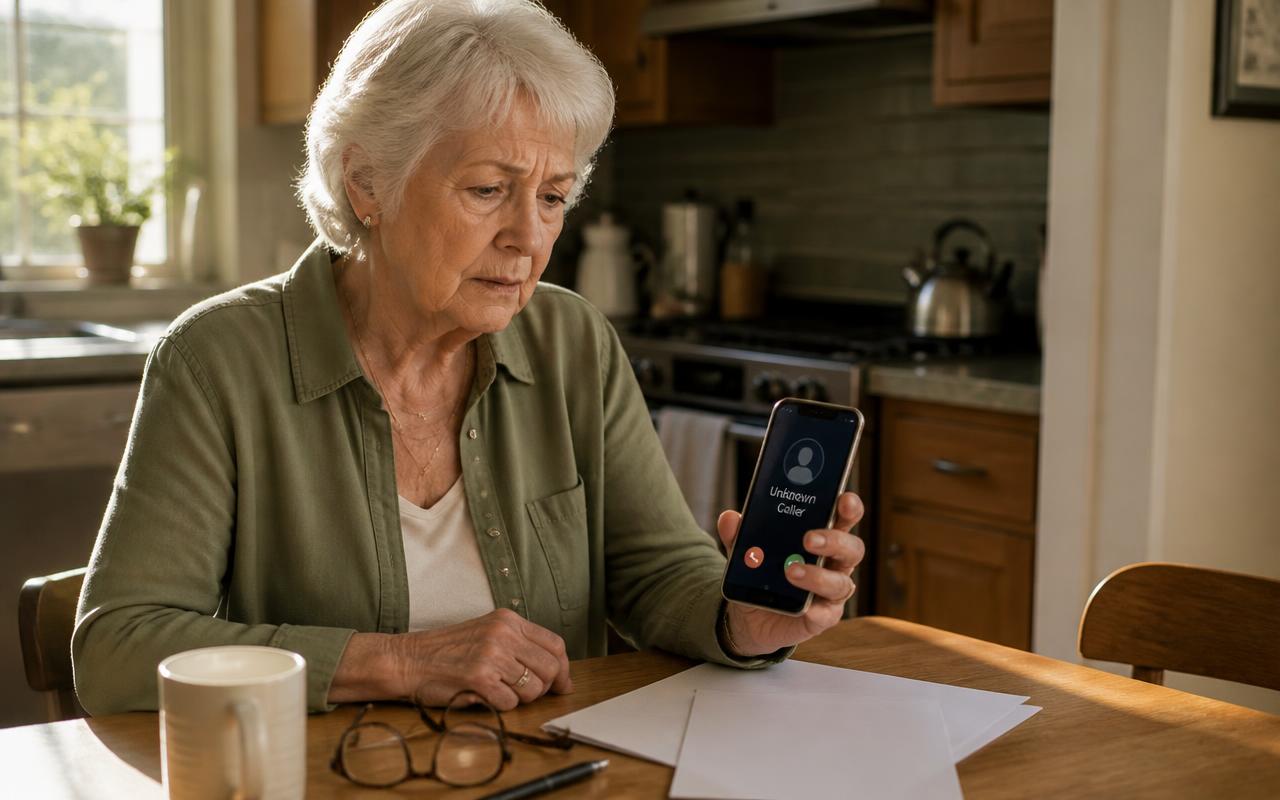
- Let unknown numbers go to voicemail. Real callers leave messages; scam auto-dialers usually don't.
- Adopt a household 24-hour rule: no money moves the same day it is requested, no exceptions.
- Agree a family safe word for any emergency call involving money.
- Create your my Social Security account at ssa.gov before a criminal does, and enable extra security.
- Freeze your credit at Equifax, Experian and TransUnion — free, reversible, and it blocks new-account fraud.
- Turn on transaction alerts for every card and bank account, and check statements monthly.
- Register on donotcall.gov and switch on your carrier's free spam-call filtering.
- Keep phones, tablets and computers set to install security updates automatically.
- Name a trusted contact with your bank and brokerage — they can pause suspicious withdrawals.
- Talk about scam calls openly at family gatherings so nobody feels ashamed to mention one.
What to do in the first hour if money already moved
- Call your bank or card issuer's fraud line immediately — wires and card payments are most recoverable in the first hours.
- If gift cards were used, call the card issuer's fraud number on the back of the card and ask them to freeze the balance.
- Change passwords for email and online banking from a different device, and turn on two-factor authentication.
- If remote-access software was installed, disconnect the computer from the internet and have it professionally cleaned.
- Freeze your credit at all three bureaus.
- Report: DOJ National Elder Fraud Hotline 1-833-372-8311, reportfraud.ftc.gov, ic3.gov, and oig.ssa.gov for Social Security imposters.
- Write down everything you remember — numbers, names, times, amounts. It helps investigators and your bank claim.
How to talk to a parent who is being scammed
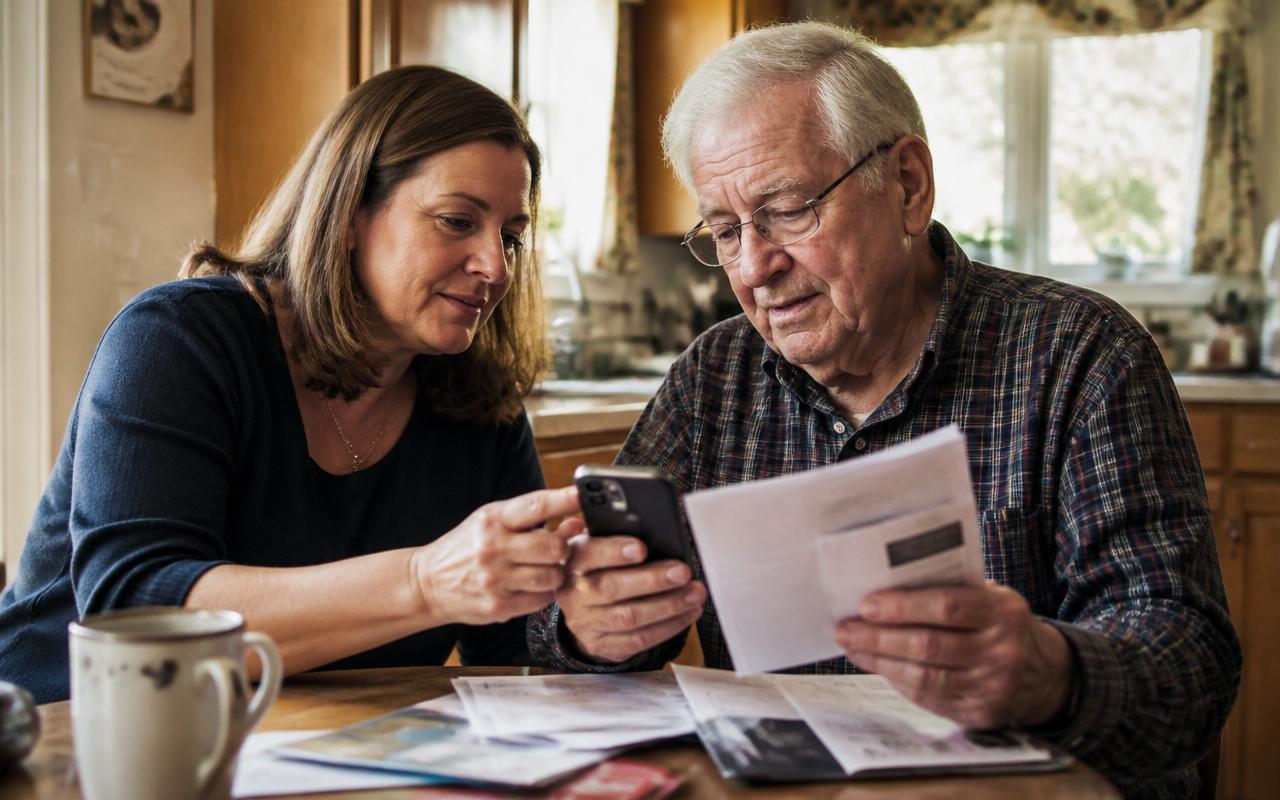
Shame keeps fraud going. Victims who are told they were foolish stop mentioning calls, and the losses compound in silence. Approach it as a shared problem: ask to look at the message together, verify by calling the real number from a statement, and blame the criminal rather than the person. Then put structure in place — transaction alerts to a second family member, a trusted contact at the bank, and the 24-hour rule — so the next attempt runs into a system rather than a moment of pressure.
Check anything suspicious before you act
If something arrived today and you are not sure, you can check it in under a minute with our free tools — paste a text or email into the scam checker, run a link through the link checker, or look up an unknown caller in the phone reputation checker. And if you want new scam scripts flagged before they reach you, Safe Retire Watch sends real-time alerts tailored to retirees in your state from $9 a month, with a 30-day money-back guarantee.
Paste a suspicious text or email — instant AI verdict.
Paste any URL before you click — free phishing check.
Get scam alerts before they reach you
Safe Retire Watch sends real-time alerts when new scams target retirees in your state. From $9/month. 30-day money-back guarantee.
Get Protected