Gift Card Scams in 2026: How They Work, Red Flags & How to Get Your Money Back
The complete plain-English guide to gift card scams targeting retirees — how Apple, Amazon, Google Play, Target, and eBay gift card scams work, the exact scripts scammers use, and the step-by-step process to try to recover your money.
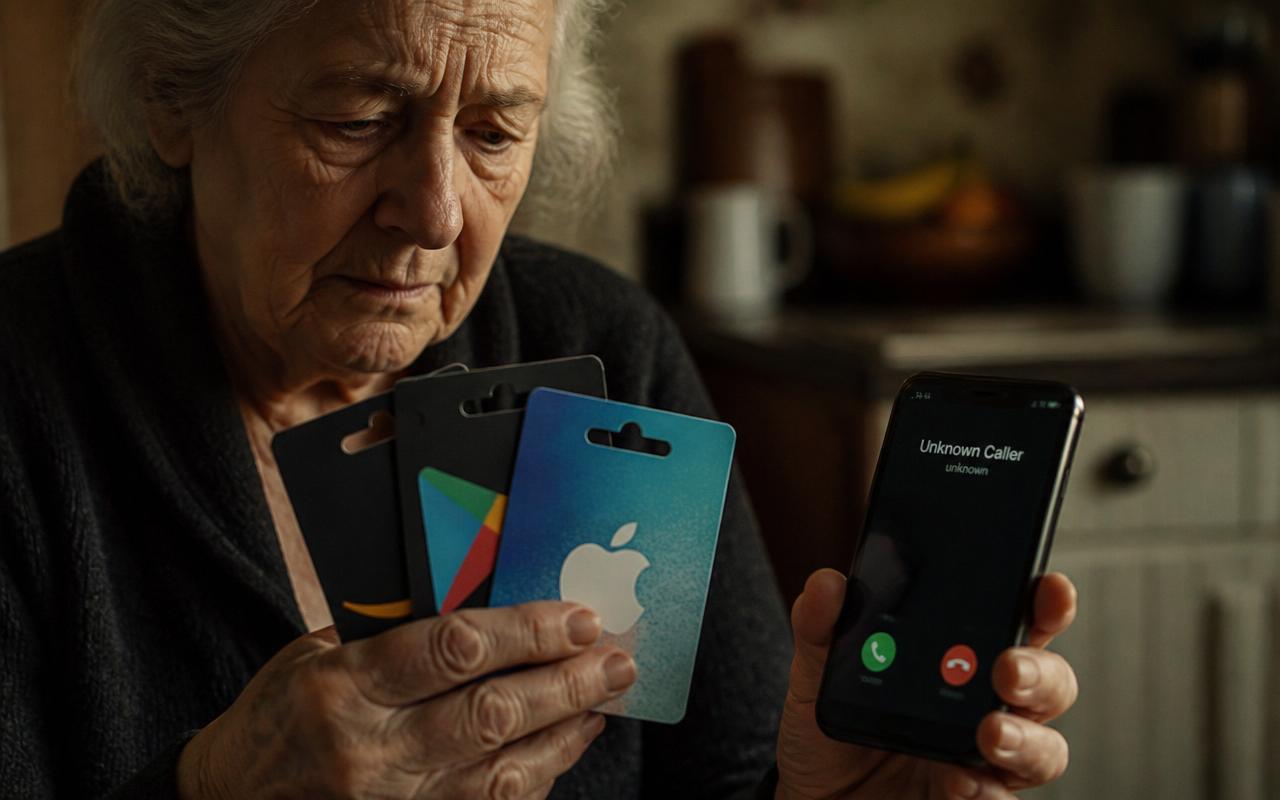
Gift cards are now the #1 payment method scammers ask for — the Federal Trade Commission reports Americans lost more than $217 million to gift card scams in the last year alone, with adults 60+ losing an average of $1,000 per case and often much more. The reason is brutally simple: once you read those 16 digits off the back of an Apple, Amazon, Google Play, Target, or eBay gift card to a stranger on the phone, the money is gone in minutes and there is almost no way to reverse it. This 2026 guide walks through exactly how gift card scams work, the seven scripts hitting U.S. seniors hardest right now, the red flags that reveal a scam in the first 30 seconds, and the step-by-step process to try to recover your money if you've already handed over the numbers.
Why scammers love gift cards
Gift cards are the perfect scammer's currency. Unlike a bank transfer, wire, or check, a gift card has no name on it, no billing address, and no way for you to cancel or claw it back. The moment you read the numbers aloud, a scammer 8,000 miles away can spend the balance, sell the card on a resale site, or move the money into cryptocurrency before you even hang up the phone. That's why every real U.S. agency — the IRS, Social Security Administration, Medicare, utility companies, courts, and law enforcement — has publicly stated they will never ask you to pay any bill, fine, or fee with a gift card. If someone on the phone tells you to buy gift cards, you are 100% talking to a criminal. There is no exception.
How gift card scams actually work (the 4-step playbook)
Almost every gift card scam — no matter what story the caller tells — follows the same four-step playbook. Learn this pattern once and you'll spot every version of it for the rest of your life:
- The hook — a phone call, text, email, pop-up on your computer, or a stranger on Facebook creates urgent fear or excitement. Your grandson is in jail. Your Social Security number is suspended. Your computer is hacked. You won a prize. Amazon just charged you $749.
- The pressure — you're told to stay on the line, not tell anyone, not hang up, and act right now. Scammers know that if you have time to think or talk to a family member, the spell breaks.
- The instruction — you're told to drive to Walmart, Target, CVS, Walgreens, Best Buy, or a grocery store and buy gift cards in specific denominations (usually $200 or $500). They'll often ask you to buy from multiple stores so cashiers don't get suspicious.
- The extraction — you read the 16-digit card number and PIN off the back to the scammer, or send a photo of the back of each card by text or email. Within minutes, the balance is drained.
The 7 most common gift card scam scripts in 2026
1. The IRS or Social Security "suspended" scam
You get a robocall or a live caller claiming to be from the IRS, Social Security Administration, or the Treasury Department. Your Social Security number has been "suspended" because of suspicious activity, or you owe back taxes and a warrant is out for your arrest. To "clear it up" you need to buy Google Play or Apple gift cards immediately. The IRS mails first. Social Security mails first. Neither agency ever accepts gift cards, calls to threaten arrest, or asks you to stay on the phone while you drive to a store. Hang up.
2. The Medicare or health insurance card scam
"We're sending your new Medicare card and there's a $199 processing fee — we can only accept it as an Amazon gift card." Medicare cards are always free, always mailed automatically, and Medicare never calls to charge a fee. Any gift card request tied to Medicare, Medicare Advantage, or a supplement plan is a scam. Hang up and, if you want to double-check anything, call 1-800-MEDICARE (1-800-633-4227) yourself.
3. The tech support pop-up scam (Apple, Microsoft, Norton, Geek Squad)
A screaming pop-up appears on your computer or tablet: "Your computer is infected — call Microsoft Support at 1-855…" You call, a "technician" takes remote control of your screen, shows you fake evidence of hackers, and tells you to pay for protection with Apple or Google Play gift cards. Real Microsoft, Apple, Norton, McAfee, and Best Buy Geek Squad will never call you, never demand gift cards, and never ask for remote access from a pop-up. Shut the browser down (Ctrl+W on Windows, Cmd+W on Mac) or force-restart the device. If a real problem exists, take the device to a local repair shop.
4. The grandparent / family emergency scam
A voice that sounds like your grandchild — often now generated by AI voice cloning from a 3-second social media video — calls sobbing that they've been in a car accident, arrested, or kidnapped in another country and need bail or hospital money by gift card, "quietly, don't tell Mom or Dad." Real jails, hospitals, and lawyers never accept gift cards. Hang up, call your grandchild's known number directly, and call their parents.
5. The utility shut-off scam
Someone claiming to be from your electric, gas, or water company calls saying your service will be disconnected in the next 30 minutes unless you pay your "past-due balance" with a Target or Walmart gift card. Real utilities send paper shut-off notices weeks in advance, never demand gift cards, and never shut power off after business hours. Hang up and call the customer-service number printed on your actual paper bill.
6. The sweepstakes, prize, or lottery scam
"Congratulations — you've won $2.5 million from Publishers Clearing House! Just pay the $499 tax and processing fee with an Apple gift card and the check is on its way." You cannot win a lottery you never entered, and no legitimate sweepstakes ever asks winners to pay any fee, especially not with a gift card. PCH itself has stated on the record: they will never ask a winner to pay.
7. The romance scam gift card ask
The person you've been talking to on Facebook, a dating site, or WhatsApp for weeks or months — who has never met you in person and always has an excuse to skip video calls — finally makes a request. Their daughter is in the hospital. They're stuck at customs and need cards to pay the fee. Their crypto wallet is locked and they need eBay cards to unlock it. Any request for gift cards from anyone you have not physically met is a scam, no matter how much you feel you've come to trust them.
12 red flags that mean you're on a scam call right now
- They mention gift cards as a form of payment — for anything, ever.
- They tell you to buy specific brands (Apple, Google Play, Amazon, Target, eBay, Steam).
- They tell you not to hang up while you drive to the store.
- They tell you not to tell the cashier what the cards are for, or to lie if the cashier asks.
- They tell you not to tell your family, spouse, or bank.
- They insist you visit multiple stores so no single cashier gets suspicious.
- They pressure you with a deadline: 30 minutes, 1 hour, "before end of business today."
- They threaten arrest, deportation, license suspension, or utility shut-off.
- They ask you to read the numbers off the back of the card, or to send a photo of the back.
- The caller ID looks like an official agency but they refuse to let you hang up and call back.
- You feel a physical sense of panic, urgency, or shame — that feeling IS the scam working.
- The story keeps escalating: first it was $200, now they need another $500, now $1,000.
What to do if you've already handed over the gift card numbers
If you've read the numbers to a scammer, act in the next 15 minutes — some cards can still be frozen if the balance hasn't been spent yet. Work down this list in order and don't stop to feel embarrassed; this happens to millions of people every year, including bank presidents, retired judges, and FBI agents' own parents.
- Call the gift card company's fraud line IMMEDIATELY. Apple gift cards: 1-800-275-2273 (say "gift card" then "fraud"). Amazon: 1-888-280-4331. Google Play: report.googleplay.com. Target: 1-800-544-2943. eBay: 1-866-961-9253. Walmart: 1-888-537-5503. Best Buy: 1-888-237-8289. Steam: help.steampowered.com. Have the card numbers, PINs, and receipts ready.
- Keep the physical cards and the receipts. Do not throw them away — the receipt proves you bought them and is required for any possible refund.
- Report to the FTC at ReportFraud.ftc.gov. Takes 5 minutes online and creates the official record needed for insurance, tax deduction, and law-enforcement follow-up.
- Report to your state Attorney General. Google "[your state] attorney general consumer complaint" — most states have a 10-minute online form.
- File a report with local police (non-emergency line) and get a case number. Many banks and insurers require one.
- If a scammer got remote access to your computer, unplug it from the internet, run a full antivirus scan, and change every password from a different device — starting with email and bank.
- Call your bank and credit card company. Tell them exactly what happened; they can flag your accounts for suspicious withdrawals and, in some cases, dispute the gift card purchase if it was on a credit card and reported fast enough.
- Tell someone you trust — a spouse, adult child, or close friend. Scammers deliberately isolate victims to keep milking them. Once one person in your life knows, the shame drops and the scam usually stops.
How to protect yourself and your parents going forward
- Print the one-sentence rule (no legitimate business ever asks for gift cards) and tape it next to every phone in the house.
- Set a family "safe word" — a random word only your family knows. Any emergency call demanding money must include it, or it's a scam.
- Never answer calls from unknown numbers. If it's real, they'll leave a voicemail. Let it go to voicemail.
- Install a call-blocker app (Nomorobo, RoboKiller, Hiya) or use your phone carrier's built-in spam filter (AT&T ActiveArmor, Verizon Call Filter, T-Mobile Scam Shield — all free).
- Sign up for scam alerts from a service like Safe Retire Watch that tells you what scripts are circulating right now in your state.
- Have a rule: any request for money — from anyone, in any amount, by any method — waits 24 hours and gets a second opinion from a family member.
- If a store cashier asks "are you buying these for yourself?" and warns you it might be a scam — LISTEN. Walmart, Target, Kroger, and CVS now train cashiers to spot gift card scams and have stopped tens of thousands of losses.
Frequently asked questions about gift card scams
Can I get a refund on a gift card I gave to a scammer?
Sometimes — if you act fast. Apple, Amazon, Google Play, Target, and Walmart have all refunded some victims when the report reaches their fraud team before the balance is spent. Call the gift card company's fraud line within the hour, keep the physical cards and the store receipt, and file an FTC report.
Will the IRS ever ask for payment in gift cards?
No — and this is on the record from the IRS itself. The IRS mails a bill first, never demands immediate payment, never threatens arrest by phone, and never accepts gift cards, wire transfers, or cryptocurrency. Every IRS gift card call is a scam.
What if the caller ID says it's Apple, Microsoft, or my bank?
Caller ID is easily spoofed — scammers can make any name and number appear on your screen, including the exact numbers on the back of your credit card. Never trust caller ID. If you're worried a call might be real, hang up and call the company back using the number on your bill, your card, or the company's official website.
How do I report a gift card scam?
Three places, in this order: (1) the gift card company's fraud line (see the recovery step above), (2) the FTC at ReportFraud.ftc.gov, and (3) your state Attorney General's consumer complaint form. If losses are over $1,000, also file with the FBI at IC3.gov.
Are gift cards from a specific store safer than others?
For your own use, gift cards from any major retailer are safe when bought and used normally. The scam risk is not the card — it's anyone on a phone or a screen telling you to buy one to pay a bill, a fee, a fine, or a debt. That request is always a scam, regardless of which brand of card is requested.
What should I do if my parent keeps falling for gift card scams?
Cognitive changes and social isolation make repeat victimization common — this is not a failure of intelligence. Have a compassionate conversation, set up call-blocking on their phone, add a spending alert or daily limit on their debit card, and consider a service that pre-screens calls. If it continues, talk to their doctor — sudden vulnerability to scams can be an early sign of memory changes worth checking.
The bottom line
Gift card scams work because they hijack fear and urgency faster than your brain can think. But every single one falls apart the moment you remember one rule: no legitimate person, business, or agency will ever ask you to pay with a gift card. If it's asked, it's a scam — every single time, with zero exceptions. Print that sentence. Tape it to the phone. Share it with everyone you love who is 60 or older. It is the single most protective piece of information any American retiree can carry into 2026.
Paste a suspicious text or email — instant AI verdict.
Paste any URL before you click — free phishing check.
Get scam alerts before they reach you
Safe Retire Watch sends real-time alerts when new scams target retirees in your state. From $9/month. 30-day money-back guarantee.
Get Protected